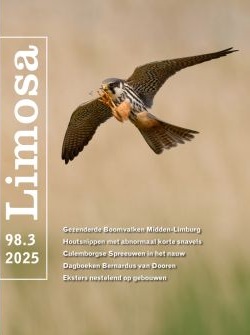
Raymond Klaassen, Adri Clements, Kjell Janssens & Henk Beckers (2025) Home range size and habitat use of Eurasian Hobbies Falco subbuteo in a Dutch agricultural landscape. LIMOSA 98 (3): 101-116.
Four adult Eurasian Hobbies were tagged in 2021-23 with
GPS-loggers to study home range size and habitat use
in an agricultural landscape in the Dutch province of
Limburg. Three birds provided sufficient data for analysis,
one female (tracked for 37 days) and two males (tracked
for 11 and 53 days). The female (Jacoba, 2021) generally
remained near the nest (90% of all positions within 600
m from the nest) and ranged only occasionally up to
about 8 km from the nest. The first male (Thei, 2021) used
a larger area (90% of all positions within 2 km from the
nest), with maximum distances of 9 km from the nest.
The second male (Lex, 2023) also used a larger area than
the female (90% of all positions within 3.2 km from the
nest), and ranged up to 11.4 km from the nest. Our results
suggest that the home range size of Hobbies is relatively
large compared to the similarly sized Common Kestrel
Falco tinnunculus, and more comparable to other wideranges
species such as Honey Buzzard Pernis aviporus and
Montagu’s Harrier Circus pygargus.
For the habitat use, the categories ‘trees and forest’ and
‘grassland’ stood out. These were also the two main
common habitat types in the area. For Lex, exceptionally
much data was obtained (13 363 GPS positions in total),
which allowed a more detailed habitat use analysis. For
example, for this bird we could distinguish between flying
and stationary positions (based on the instantaneous
speed). This showed a preference for ‘trees and forest’
for stationary positions and a preference for ‘grassland’
for flying positions. By using the Dutch tree database
(bomenregister.nl), we could show that Lex was mainly
using relatively large trees such as Aspen Populus sp.,
probably as watch points for hunting. For the flying
positions also a preference for the categories ‘Other’,
‘Roads’ and ‘Buildings’ was noted. This turned out to be
related to the bird hunting near dairy farmyards. The
preference for grasslands and farmyards reflects the diet of
the Hobbies in the study area that mainly consist of birds
such as swallows Hirundinidae, and sparrows Passer sp.
In the varied agricultural landscape of the Dutch river
Maas valley, Hobbies have notably large home ranges. The
question is whether this is a natural aspect of their aerial
lifestyle, or whether a large home range is a sign of (too)
low prey population densities. Conservation measures
such as Nature 2000-areas and Agri-Environment
Schemes do not seem particularly important for foraging
Hobbies, thus the conservation of the enigmatic species
in agricultural landscapes seems to depend in the first
place on the conservation of common bird prey species.
[pdf only for members] [dutch summary]
|